

As Malaysia’s junior squad makes its debut at the prestigious Murugappa Gold Cup in Chennai, the country’s broader hockey ambitions are quietly but steadily being rebuilt — from the ground up.
Once a regional powerhouse that clinched silver at the 2018 Asian Games and regularly challenged Asia’s best, including India, Malaysia now languishes at No. 12 in the FIH world rankings. To arrest the slide, the Malaysian Hockey Confederation (MHC) handed the reins to two-time Olympian Sarjit Singh 14 months ago.
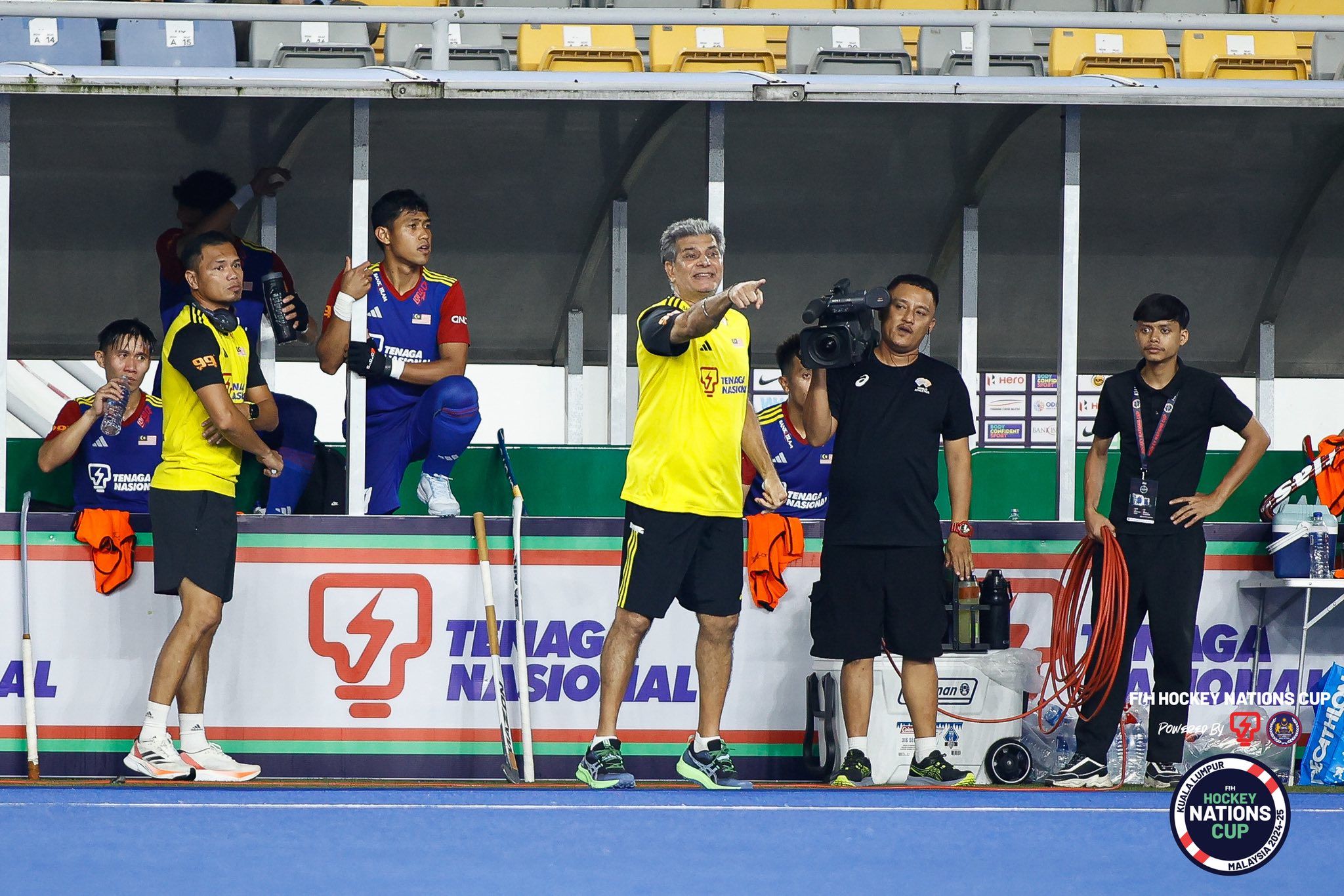
In just over a month, Sarjit will lead his side into the Asia Cup in Rajgir, India (August 27 – September 7) — a tournament that doubles as a qualifier for the 2026 Hockey World Cup. But unlike the usual pre-tournament hype, there are no bold promises coming from the Malaysian camp.
“No Goals Set for Asia Cup”
Despite publicly vowing to resign if Malaysia fails to qualify for the World Cup, Sarjit isn’t setting any benchmarks for the Asia Cup — not because he lacks ambition, but because his mission is much bigger.
We are just building a team. We have not set any goals for the Asia Cup because it’s a new team. If you set targets with a new team, you put the players under pressure. We don’t want to do that.
That vow to step down came after Malaysia’s sixth-place finish at the Nations Cup — a second-tier tournament under the Pro League — which included a shock defeat to Wales.
“They (MHC) brought me here to qualify for the 2028 Olympics. If I think I can’t do the job, and if we don’t qualify for the World Cup next year, I will resign,” Sarjit had declared after the Nations Cup disappointment.
Instead, he’s focused on a broader horizon.
“We are trying to build a strong team for the next Olympics (LA 2028) and also for 2032. That is the Malaysian hockey team’s program now.”
The Transition Challenge: Icons Out, Youth In
Malaysia’s transition was underscored earlier this year when star forward and drag-flicker Faizal Saari retired from international hockey — a major loss not just for his scoring abilities, but for his experience.
To steady the ship, Sarjit brought back seasoned campaigner Faiz Helmi Jali (229 caps) to join captain Marhan Jalil (234 caps) and Fitri Saari (181 caps) in guiding the younger group.
But the coach is clear: experience alone isn’t enough — Malaysia needs more match exposure.
When you get new players, they need matches to get exposure. I took over the team last year; it’s been 14 months. In that period, we have played only 17 matches, which is not good enough. You need at least 40 to 45 matches in one year.
Defence, Flicks and a Missing Wall
Three glaring gaps Sarjit is looking to fix: defence, drag flickers, and a quality goalkeeper.
Malaysia’s penalty corner woes were visible in the last Asia Cup, where they converted just 4 PCs — only better than Japan’s 2. The absence of Faisal Saari is being felt acutely.
“Faisal was one of our best flickers,” Sarjit admitted. “Now we are training three more flickers, but you can’t expect results from them immediately. That will take time.”
Then there’s the issue between the posts. Since S. Kumar’s retirement in 2020, Malaysia has yet to find a stable goalkeeper — not unlike India, who are still adjusting after PR Sreejesh stepped down post-Paris 2024.
We also need a good goalkeeper. After Kumar retired, we have been struggling. The defenders are inexperienced too. We need to build a solid backline.
Sohail Abbas Joins the Project
In a bold move last October, the MHC signed legendary Pakistani drag-flicker Sohail Abbas — the all-time top scorer in international hockey (348 goals in 315 matches) — on a one-year contract to nurture the next generation of PC specialists.
He is doing his part; but he needs time. You can’t just have a team and get results immediately. That never happens.
There may be political friction brewing ahead of the Asia Cup, which is being held in India. While Pakistan's participation remains under a cloud due to diplomatic tensions, Sohail’s travel as part of Malaysia’s support staff is expected to go ahead unhindered — unless regional politics takes an unexpected turn.
Signs of Hope: Malaysia’s Youth on the Rise
Amid all the rebuilding, there are early green shoots. Malaysia’s under-18 squad clinched bronze at the U-18 Asia Cup, beating Bangladesh 5-2 in the third-place playoff.
It may not sound headline-worthy — but it’s a timely sign that Malaysia’s hockey nursery is alive and hopeful.
And if Sarjit’s senior team can turn in a spirited performance at the Asia Cup — even without lofty expectations — it will be another crucial step in Malaysia’s long but purposeful climb back to the top.