


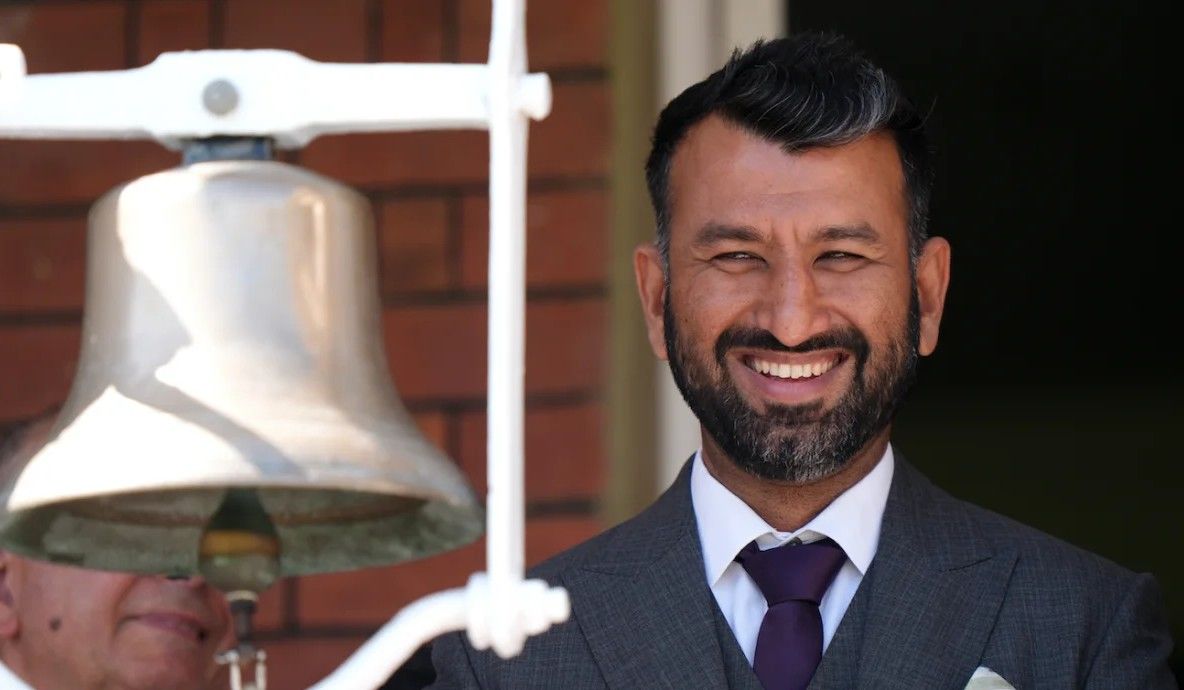
The label of a devotee of Test cricket has stuck with Cheteshwar Pujara forever. From Prime Minister Narendra Modi to the global cricket community, praise has continued to pour in for his contribution to the longer format since his retirement just over a week ago.
The White-Ball Question
However, it’s not as if Pujara was averse to white-ball cricket. Deep down, one senses a trace of hurt at being typecast as a red-ball player for his entire career. It’s almost embarrassing to realise that a batter of his stature finished with just five ODIs and was virtually an outcast in the IPL – despite a few appearances for Kolkata Knight Riders and Chennai Super Kings.
It was around 2015, after I had gone unsold for two years in a row at the IPL auction, that I realised I may not be able to create a niche in India’s white-ball set-up. That’s when I made peace with myself and decided to focus on Test cricket and give my best there.
The Dravid Successor
An aggregate of 7,195 runs from 103 Tests, including 19 centuries – nine of them overseas – is impressive, yet it hardly reflects the calm assurance and resilience Pujara brought to India’s middle order. Virat Kohli once said that Pujara’s presence at No.3 invariably made his own job easier at No.4, while former England captain Nasser Hussain placed his contribution in fine perspective.
Hussain told Sky Sports: "In our era, the best batter in the team invariably came in at No.3 – like Viv Richards or Ricky Ponting. Pujara, in his way, had taken over from one of the all-time greats in Rahul Dravid and was phenomenal as an old-school No.3."
If Virat feels that I made his life easier at No.4, then it seems I did my job. As a top-three batter, my responsibility was to bat for the first 25–30 overs, or however long it took, to take the shine off the ball so that those coming in at four to seven could do their job.’
Battling the Aussies
Stories of Pujara’s passion and hunger to occupy the crease continue to surface, particularly his marathon efforts in India’s back-to-back Test series wins in Australia in 2018–19 and 2020–21, which drew repeated admiration from the opposition.
Yes, I’ve heard the likes of Cummins, Hazlewood and even Nathan Lyon praising me publicly – which has been satisfying. Lyon once said I’m a tough batter to dismiss. The Aussies play the hard way, and even if you need 80–100 runs against them for a win, they will make life difficult.
Advice for the Next Generation
In hindsight, one piece of advice from Pujara to the new generation stands out – he urged them to become all-format players. Does that reflect any regret over being typecast himself?
It was a pragmatic suggestion. I think upcoming players should try to become all-format batters. If you look closely, we play only about nine Tests in a year, so one has to prepare harder by playing domestic matches to stay in rhythm. But in white-ball cricket, there are many more opportunities – the Vijay Hazare Trophy, Syed Mushtaq Ali, and of course, the IPL, which gives huge leverage.
Moving On with Grace
How difficult was it psychologically for a proven player like Pujara to motivate himself to continue with Saurashtra or in remote county venues after his last Test in the 2023 WTC final against Australia?
Over the last two years, I told myself to just enjoy my cricket and not worry about chances. There was no pressure, but I felt it was the right time to move on and allow younger players in Saurashtra their opportunity.