




As new businesses models proliferate, a widespread pattern in telecom is for one operator to imitate another. Handset subsidies, prepaid billing, unlimited usage pricing plans and push-to-talk are but a few examples.
App stores are another case in point. But operators that emulate their superficial characteristics do so at their peril. There are several key strategic decisions that operators must make in establishing what is a complex and subtle business model, and on which the success or failure of an app store initiative depends.
 App stores represent a quantum change in the way the telecom industry responds to propagating innovation - in fact, a change in the way operators navigate themselves through what is a more complex and more quickly evolving landscape than faced in the past.
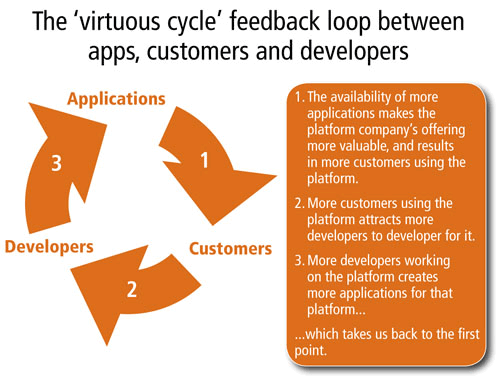
App Stores are usually implemented as two-sided business models. As described by Evans, Hagiu and Schmalensee in "Invisible Engines: How Software Platforms Drive Innovation and Transform Industries" (MIT Press, 2006), these differ from traditional linear supply chains in that a platform company relies on a community of third-party developers to enhance the value of the platform by creating applications for it.
The idea behind the two-sided model is to increase the platform vendor's market penetration, via the "virtuous" cycle (see diagram above).
If all goes well, a savvy platform company can ride this cycle to dramatically grow its customer base, as has been proven in several industries. Note, however, that the converse is also true. If a vendor fails to attract developers, it will have fewer applications and therefore lose customers to application-rich competitors, making it even harder to attract developers. So this is not a sure-fire strategy.